
Global Trade • Maritime Infrastructure
Navigating the Blue Economy: Maritime Trade, Decarbonisation and Port Infrastructure Trends
Geopolitical rerouting around African chokepoints has spiked ton-mile emissions while the IMO negotiates global greenhouse gas pricing. Inside the multi-trillion-dollar race to decarbonize global shipping fleets and build climate-resilient green ports.
Commercial maritime transport carries more than 80 percent of global merchandise trade by volume, serving as the physical circulatory system of international commerce. Yet global shipping is navigating an era of acute operational turbulence. Following modest expansion in 2024, the United Nations Conference on Trade and Development (UNCTAD) forecasts seaborne trade volume growth decelerating to approximately 0.5 percent amid rising geopolitical friction, protectionist tariff realignments, and strategic chokepoint closures.
Security crises in the Red Sea have forced commercial fleets away from the Suez Canal, diverting thousands of container vessels and tankers around the Cape of Good Hope. By mid-2025, Suez transit tonnage remained 70 percent below baseline 2023 levels. These extended maritime voyages increased global ton-miles by six percent in a single year, causing total maritime shipping emissions to rise five percent as vessels burned additional bunker fuel to maintain delivery schedules across longer oceanic arcs.
"The maritime sector faces a dual mandate: adapting port infrastructure to withstand severe coastal climate damages while re-engineering global vessel fleets to operate on zero-carbon fuels."
Decarbonisation Mandates: The IMO Net-Zero Framework
International shipping generates roughly 1,076 million metric tons of carbon dioxide annually, accounting for nearly three percent of total global greenhouse gas emissions. Without aggressive intervention, baseline projections indicate that maritime emissions could expand by more than 100 percent by 2050. Currently, only eight percent of the world fleet by deadweight tonnage is configured or retrofitted to consume low-carbon alternative fuels.
In response, the International Maritime Organization (IMO) approved a draft Net-Zero Framework in April 2025. Designed to enter into legal force around 2027 for vessels over 5,000 gross tonnage, the architecture pairs a mandatory well-to-wake greenhouse gas fuel intensity standard with an international carbon pricing mechanism. Ships emitting above prescribed greenhouse intensity thresholds must purchase remedial compliance units, with revenues directed into a maritime transition fund supporting developing nations and port technology deployments.
| Year | Institutional Action | Regulatory Mechanism | Industry Impact |
|---|---|---|---|
| 2018 | Initial IMO GHG Strategy | 50% aggregate emissions reduction target by 2050 | Established initial energy efficiency design standards for newbuilds |
| 2023 | Revised Strategy Adoption | Commitment to net-zero emissions by or around 2050 | Accelerated orderbook shift toward dual-fuel vessel designs |
| 2024 | EU ETS Maritime Phasing | Mandatory surrender of EU allowances for voyage emissions | First regional direct carbon tax imposed on large merchant ships |
| 2025 | Draft Net-Zero Framework | Global fuel intensity cap paired with universal GHG pricing | Covers ~85% of international emissions; adoption vote scheduled |
| 2027 | Projected Enforcement | Mandatory well-to-wake emission caps | Requires non-compliant carriers to purchase remedial compliance credits |
In parallel, the European Union has moved ahead unilaterally. Under the EU Emissions Trading System (EU ETS), large merchant ships entering European ports must surrender emission allowances for carbon dioxide output, establishing the world's first mandatory regional carbon price on oceanic shipping.
Alternative Fuel Pathways: Ammonia, Methanol, and Wind Propulsion
Carriers are deploying substantial capital into alternative propulsion technologies. Shipbuilders report that 37 percent of commercial vessels currently on order by cargo capacity include energy-saving technologies such as air lubrication systems and hydrodynamically optimized hulls, compared to 22 percent in 2021.
Leading fuel candidates include green ammonia, biomethanol, and green hydrogen. Ammonia offers zero carbon combustion but introduces severe handling hazards due to acute toxicity, requiring specialized bunkering protocols currently being developed by the Port of Rotterdam and the Maritime and Port Authority of Singapore. In May 2025, Rotterdam signed a landmark agreement with AM Green to establish a supply chain capable of importing one million tons of green ammonia annually from India by 2030.
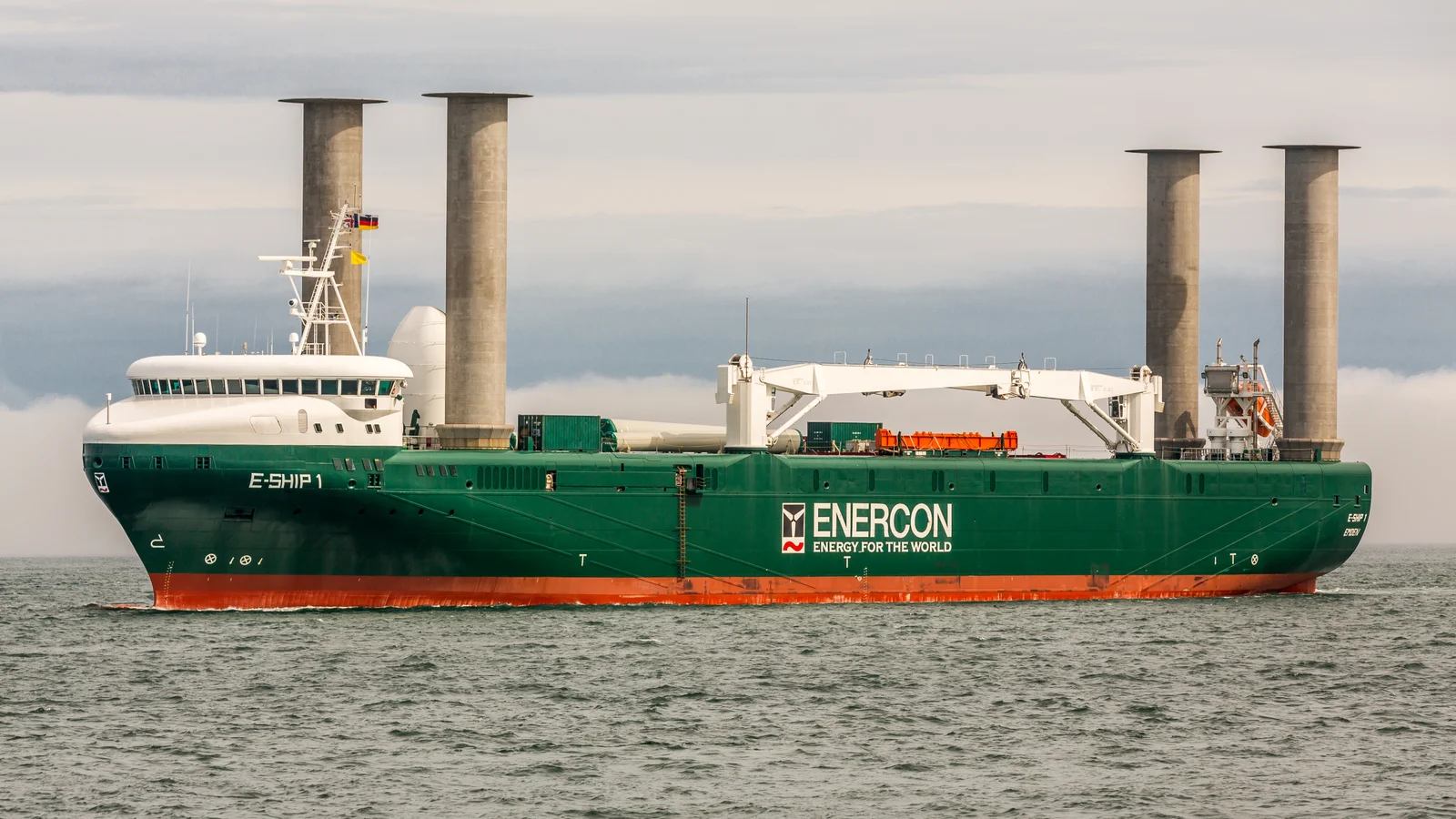
Wind-assisted propulsion has also transitioned from experimental novelty to verified commercial deployment. Modern vessels such as the E-Ship 1 utilize large vertical Flettner rotors. These rotating cylinders harness the Magnus effect to convert perpendicular ocean winds into forward thrust, delivering fuel savings between 10 and 15 percent depending on route wind consistency.
Port Resilience and Climate Adaptation Capital
Ports serve as the physical interface between maritime trade and overland logistics. Because ports are situated at sea level on dynamic coastal estuaries, they represent frontline casualties of climate volatility.
A comprehensive climate risk assessment by the Global Center on Adaptation revealed that African ports currently face $5.3 billion annually in climate-related trade disruption risks. By 2050, baseline physical damage costs could reach $680 million per year. At Benin's Port of Cotonou, extreme heat stress already reduces outdoor worker productivity by 10 percent on high-temperature days, a figure projected to cause cumulative economic losses exceeding 13 million euros without mitigation.
| Port / Authority | Primary Initiative | Decarbonisation & Resilience Goal | Financing Commitment |
|---|---|---|---|
| Port of Rotterdam (Netherlands) | Offshore wind terminals, hydrogen bunkering | Net-zero operations by 2050; 1M t/yr green ammonia | $1B+ joint bilateral supply chain |
| Port of Vancouver (Canada) | Shore power, terminal electric handling vehicles | Carbon neutral operations by 2050; 3.8M TEUs capacity | CAD $150M+ capital upgrade budget |
| Singapore MPA (Singapore) | Green Port Programme, alternative fuel incentives | Zero-emission harbor craft by 2030; biofuel bunkering | SGD $150M maritime green fund |
| African Ports Adaptation (GCA) | Sea defenses, heat shelters, automated drainage | Mitigates up to 70% of projected $5.3B annual trade at risk | Multilateral climate resilience grants |
Crucially, targeted adaptation investments yield high returns. Installing advanced drainage, elevating wharf crane tracks, constructing protective seawalls, and instituting shaded cooling stations can reduce climate-related trade losses by up to 70 percent. Multilateral institutions are mobilizing capital to bridge this gap: the Asian Development Bank has established a $1 billion Sustainable and Resilient Maritime Fund, while bilateral green bonds are underwriting deepwater modernization across the Caribbean and Southeast Asia.
The Expanding Blue Economy: Offshore Energy and Digital Resilience
Beyond cargo shipping, the broader blue economy encompassing offshore renewable energy, aquaculture, and marine technology reached $2.2 trillion in global trade value by 2023. Offshore wind capacity expanded to 92.5 gigawatts by 2025, powering more than 100 million households and creating industrial synergy with adjacent ports that fabricate turbine nacelles and export subsea power cables.
However, digital automation introduces new vulnerabilities. As commercial ports deploy autonomous straddle carriers, automated terminal operating systems, and blockchain-based customs clearing, cybersecurity has become a critical operational concern. Protecting automated port systems against hostile nation-state intrusion and ransomware extortion is now viewed as an essential component of national infrastructure security.
The Editorial Perspective
Decarbonising international maritime trade represents a capital investment challenge estimated between $1.0 and $1.9 trillion by 2050. The transition cannot occur through voluntary corporate pledges alone.
Carrier willingness to pay voluntary green freight premiums fell from 4.5 percent in 2024 to 3.0 percent in 2025 as economic headwinds tightened operating margins. Without binding statutory frameworks that establish global greenhouse gas pricing and enforce uniform fuel standards, private shipowners will remain hesitant to commit billions to alternative-fuel newbuilds. The coming regulatory cycle at the International Maritime Organization will determine whether the maritime trade complex builds a resilient, zero-carbon logistics highway or remains locked into carbon-intensive fuels for another generation.
References & Empirical Documentation
- • UNCTAD, Review of Maritime Transport: Geopolitical Chokepoints and Ton-Mile Emissions, 2024.
- • International Maritime Organization (IMO), Draft Net-Zero Framework and Greenhouse Gas Strategy Revisions, MEPC 82, 2025.
- • Global Center on Adaptation (GCA), Climate Risk and Port Adaptation Investment Across African Hubs, 2024.
- • Boston Consulting Group (BCG), Shipper Sentiment Survey: Willingness-to-Pay for Green Maritime Corridors, 2025.
- • Port of Rotterdam Authority, Bilateral Green Hydrogen and Ammonia Supply Chain Frameworks, May 2025.
- • Asian Development Bank (ADB), Financing Resilient Maritime Port Infrastructure in the Asia-Pacific Region, 2024.